

Crude oil remains one of the most important and volatile assets in global financial markets. In 2026, oil prices are being driven not just by supply and demand - but by geopolitics, electrification trends, and structural shifts in the global energy system.
With the ongoing Iran-Israel-US conflict and disruptions in the Strait of Hormuz, combined with long-term changes highlighted in the latest International Energy Agency report, understanding oil has never been more critical.
Crude oil remains one of the most important and volatile assets in global financial markets. In 2026, oil prices are being driven not just by supply and demand - but by geopolitics, electrification trends, and structural shifts in the global energy system.
With the ongoing Iran-Israel-US conflict and disruptions in the Strait of Hormuz, combined with long-term changes highlighted in the latest International Energy Agency report, understanding oil has never been more critical.
What Is Crude Oil and Why It Still Dominates Markets
Crude oil is a core global commodity, used in transportation, manufacturing, petrochemicals, and energy production. Despite the rise of renewables, oil still plays a central role in the global economy.
According to the International Energy Agency, global oil demand is still growing in 2026, with consumption expected to increase by around 930,000 barrels per day this year.
Brent vs WTI Oil: Understanding the Key Benchmarks
Brent Crude
- Sourced from the North Sea
- Global pricing benchmark (70% of global oil)
- More sensitive to geopolitical disruptions
WTI (West Texas Intermediate)
- Produced in the United States
- Delivered via inland infrastructure
- Typically slightly cheaper than Brent
Key Trading Insight
In 2026, geopolitical disruptions especially in the Middle East have caused:
- Brent to react more aggressively
- WTI to occasionally diverge due to US supply stability
For traders, this creates arbitrage and spread trading opportunities.
How to Trade Oil via CFDs on XTB
Trading oil through CFDs (Contracts for Difference) is one of the most accessible ways to speculate on oil prices.
The easiest way to trade in the oil market is to use our XTB app, which is a complete investing and trading tool that gives you the opportunity to invest in a wide range of financial instruments. Thanks to the calculator built into the order window, you can set the Stop Loss or Take Profit order in accordance with the assumptions resulting from your own investment strategy.
First, let's look at how to place a buy order, otherwise known as a long position. Let us assume that, after analysing the market, you believe that the price of oil is going to rise in the near term. Initially, you should determine the size of the transaction. Initially, you should determine the size of the transaction. Next, you could set up a Stop Loss order to limit your potential losses and a Take Profit order that will close the order when you make a profit. The easiest way to enter a new transaction is by searching for the instrument you would like to trade; in this case, let’s use oil. You can either search for it in the top-right corner, or it may appear under the “HOT” traded instruments.
If you click on the chart, it will expand, allowing you to view how the instrument has performed over the past week, month, year, and more.
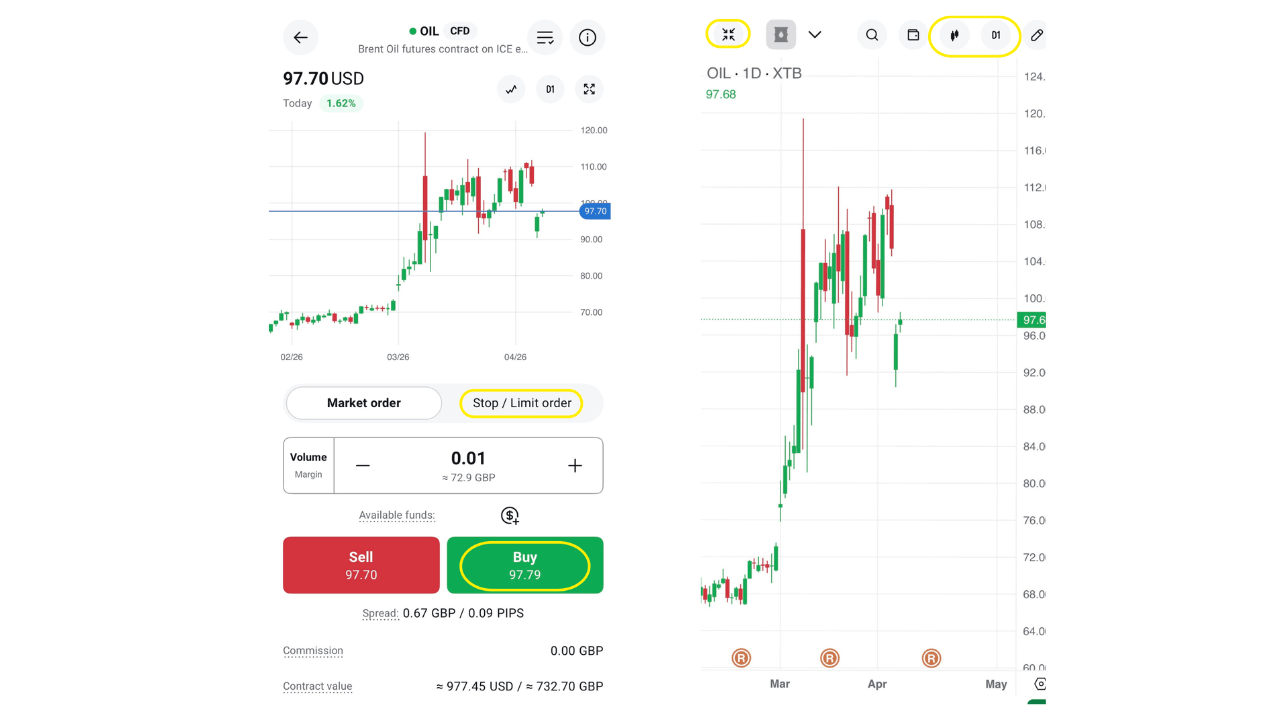
Source:XTB app. Please be aware that the presented data refers to the past performance data and as such is not a reliable indicator of future performance.
Once you have placed the trade, you can view your open positions by navigating to the Home section and selecting “My Trades.” There, you can see all Open, Pending, Closed, and Cash Operations.
If the market is open, the order should normally be filled. The status of the transaction is visible in the Open Positions window. When you are ready to close your position, you can click “Close,” reverse your initial trade, or select the trade (or “Select All”) and press “Close All.”
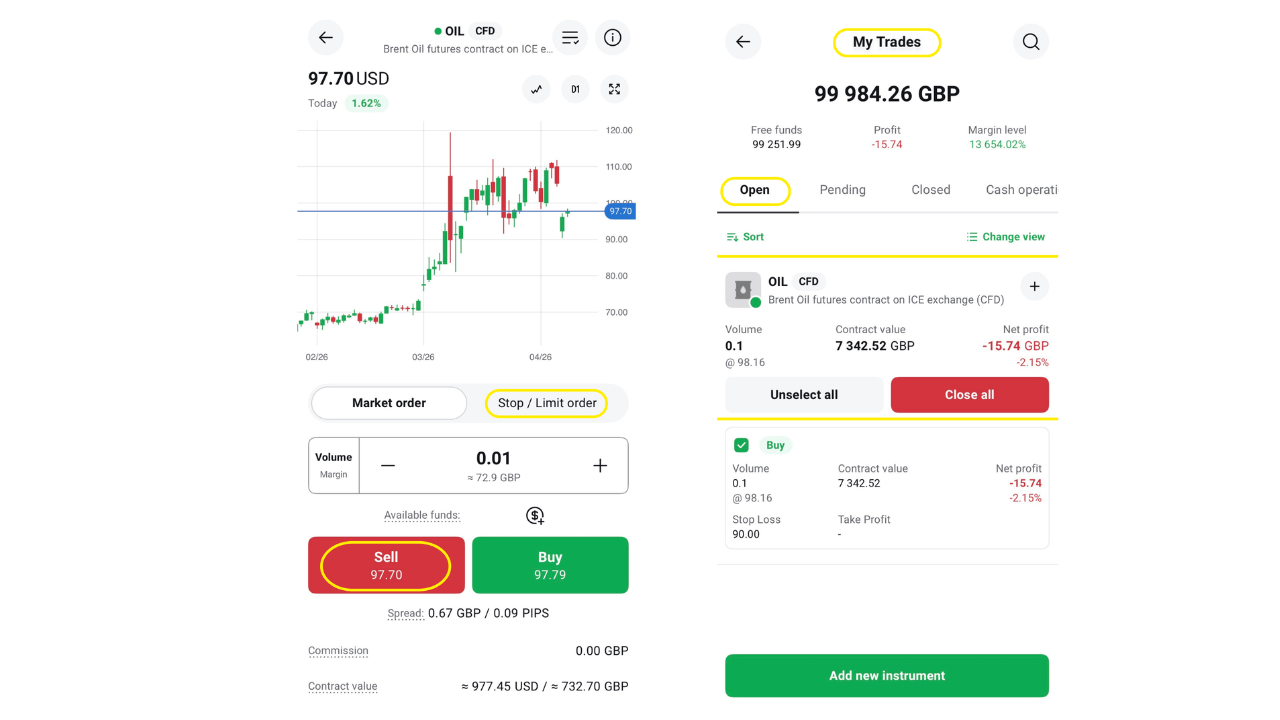
Source:XTB app. Please be aware that the presented data refers to the past performance data and as such is not a reliable indicator of future performance.
What Are Oil CFDs?
CFDs allow you to trade price movements without owning physical oil.
Key Features:
- Go long (buy) or short (sell)
- Use leverage
- Trade Brent and WTI directly
Oil Instruments on XTB
- Brent ( listed as OIL)
- WTI (OIL.WTI)
Why Traders Use CFDs
- Profit from volatility
- Low capital requirements
- High liquidity
Risks to Consider
- Leverage increases losses
- Highly news-driven market (especially now)
- Overnight financing costs
Alternative Ways to Invest in Oil via XTB
1. Oil ETFs
Oil ETFs are a popular long-term investment option.
Types include:
Futures-based oil ETFs
Energy sector ETFs (oil companies)
Core oil & gas equity ETFs (physical ETFs)
These are the most straightforward “oil exposure via equities” options:
→ Focus: global upstream oil & gas companies (exploration & production)
→ One of the purest equity plays on oil prices
→ Focus: large European oil majors (Shell, BP, Total, etc.)
→ More defensive, dividend-heavy exposure
→ Focus: oil services companies (drilling, equipment, infrastructure)
→ Higher beta to oil cycles
Important: Most ETFs on XTB give equity exposure, not direct crude oil tracking.
If you want direct oil price exposure, XTB mainly offers:
- Oil CFDs (Brent / WTI)
- Oil ETCs (exchange-traded commodities)
👉 This is a key distinction:
- ETFs = oil companies
- ETCs / CFDs = actual oil price
ETF CFDs on oil sector (more trading-oriented)
If you’re using leveraged products, XTB also provides ETF CFDs like:
- Leveraged (typically ~1:5)
- Short-term trading instruments rather than long-term investing
Benefits:
- Lower volatility than CFDs
- No leverage required
- Easier diversification
2. Oil Stocks
Invest in companies like:
- Oil producers
- Refiners
- Energy service firms
These are influenced by oil prices but also company earnings.
3. Energy Transition ETFs
These include both:
- Traditional oil exposure
- Renewable energy companies
- Increasingly relevant in 2026.
What to Look for When Investing in Oil
Oil prices are influenced by several critical factors:
1. Supply & OPEC+
Production quotas and geopolitical alliances still drive supply.
2. Global Demand
Demand remains strong but is changing structurally.
3. Inventories
US crude stockpiles and global reserves matter.
4. USD Strength
Oil is priced in dollars - stronger USD = weaker oil (usually)
5. Energy Transition Trends (NEW KEY FACTOR)
This is where the IEA Electricity 2026 report becomes crucial.
The Energy Transition: Why Electricity Is Changing Oil Markets
The Electricity 2026 highlights a major structural shift:
1. Electricity Demand Is Exploding
- According to Power Library global electricity demand is growing - 3.6% annually through 2030
- Demand is rising 2.5x faster than overall energy demand
2. Renewables Are Taking Over Growth
- Renewables, gas, and nuclear will meet all new electricity demand
- Solar and wind are rapidly expanding
3. Oil Is Being Replaced in Power Generation
- Fuel switching from oil - gas and renewables is accelerating
Key takeaway for investors:
Oil is shifting from a growth asset - a strategic and cyclical asset.
The 2026 Oil Crisis: Iran, Israel, US & Strait of Hormuz
What’s Happening?
The current geopolitical crisis involves:
- Iran
- Israel
- The United States
The conflict escalated into direct military confrontation, affecting global energy supply.
Strait of Hormuz: The Critical Chokepoint
The Strait of Hormuz is one of the most important oil routes in the world:
- 20% of global oil supply passes through it
- Connects Middle Eastern producers to global markets
Its temporary closure in 2026 caused:
- Supply shock
- Shipping disruptions
- Massive price spikes
Market Impact: Oil Price Volatility
During Escalation:
- Oil surged toward $150/barrel
- Supply fears dominated
After Ceasefire:
- Prices dropped sharply
- Markets stabilised but remain elevated
Ceasefire: What It Means
The ceasefire between Iran and the US:
- Reduced immediate supply fears
- Allowed partial reopening of shipping routes
- Lowered oil prices short-term
BUT:
- It remains fragile
- Infrastructure damage persists
- Risk of re-escalation is high
Key Strategies for Trading Oil in 2026
1. Trade the News
Oil reacts instantly to geopolitical developments.
2. Watch Energy Transition Trends
Electricity growth and renewables are reshaping long-term demand.
3. Use Risk Management
- Always use stop-loss
- Avoid excessive leverage
4. Understand Market Structure
- Futures curves
- Supply disruptions
- Regional price spreads
5. Combine Strategies
- CFDs for short-term trades
- ETFs for long-term exposure
Final Thoughts: Is Oil Still a Good Investment?
Oil in 2026 is defined by two opposing forces:
Bullish Factors:
- War and geopolitical instability
- Supply disruptions
- Strong emerging market demand
Bearish Factors:
- Electrification
- Renewable energy growth
- Structural demand shifts
According to the IEA, the world is entering the “Age of Electricity”, where power demand is growing faster than overall energy demand.
Conclusion
Crude oil remains one of the most dynamic markets in the world but it is evolving rapidly.
In the short term, prices are driven by war, supply shocks, and geopolitical headlines In the long term, electricity, renewables, and energy transition trends are reshaping demand Whether you're trading oil via CFDs on XTB, investing in ETFs, or analysing Brent vs WTI, success in 2026 requires understanding both: Geopolitics and the energy transition.
CFDs are complex instruments and come with a high risk of losing money rapidly due to leverage. 71% of retail investor accounts lose money when trading CFDs with this provider. You should consider whether you understand how CFDs work and whether you can afford to take the high risk of losing your money.

How to Take Advantage from Falling Prices
The history and future of Natural Gas
How to Invest in Gold - How to buy digital gold with XTB
This content has been created by XTB S.A. This service is provided by XTB S.A., with its registered office in Warsaw, at Prosta 67, 00-838 Warsaw, Poland, entered in the register of entrepreneurs of the National Court Register (Krajowy Rejestr Sądowy) conducted by District Court for the Capital City of Warsaw, XII Commercial Division of the National Court Register under KRS number 0000217580, REGON number 015803782 and Tax Identification Number (NIP) 527-24-43-955, with the fully paid up share capital in the amount of PLN 5.869.181,75. XTB S.A. conducts brokerage activities on the basis of the license granted by Polish Securities and Exchange Commission on 8th November 2005 No. DDM-M-4021-57-1/2005 and is supervised by Polish Supervision Authority.
