





Read more
110+ stocks

Trade options on U.S. stocks

Open long or short positions while risking only the premium paid.

Low entry threshold

Manage risk precisely with option contracts of low nominal value.

Free account opening

Complete the process in 15 minutes without unnecessary paperwork.

110+ options

Choose from options on U.S. stocks.

Invest in rising and falling markets

Be prepared for any market scenario with the ability to invest in both upward and downward movements through available options.

Open account 
Control potential losses

Rest assured that the only amount you risk is the predetermined option premium you paid.

Investing

How do options work?

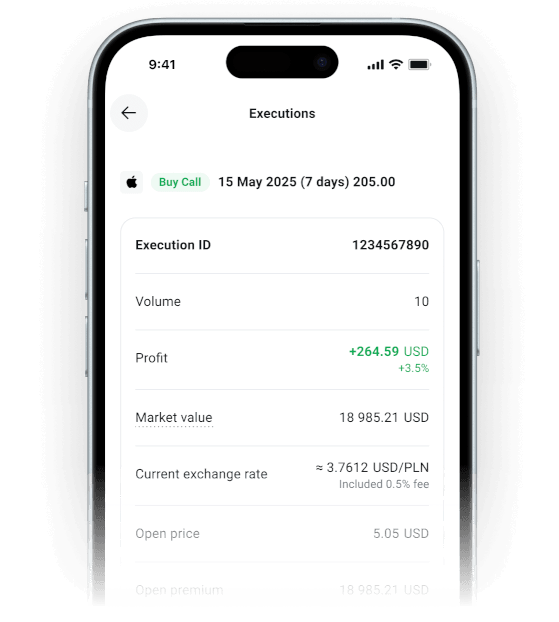
Select from 110 stocks and decide whether you expect the asset price to rise or fall.

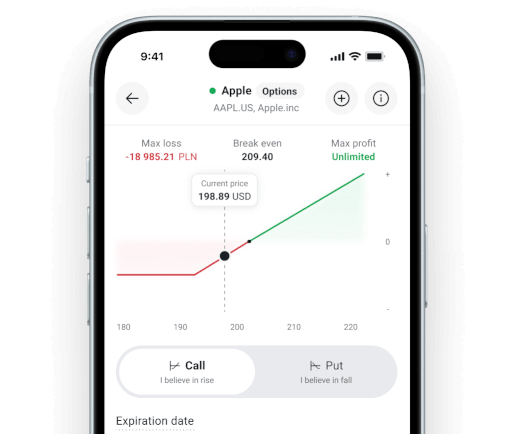
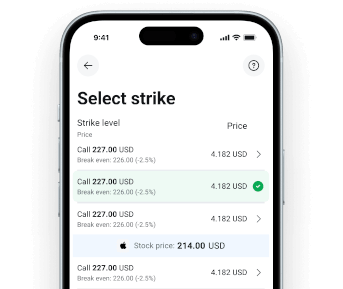
Choose the expiration date, strike price, and review potential profit and loss.

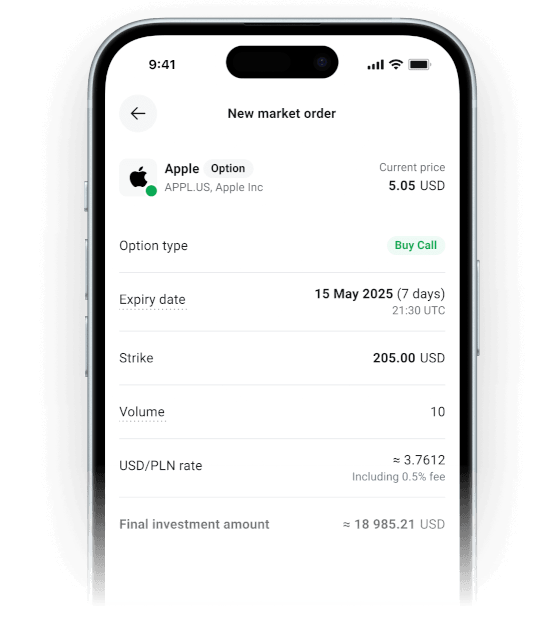
Confirm the trade details and pay the option premium — this is the risk you take as an option buyer.

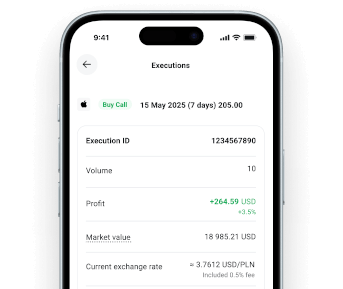
Monitor the market and, depending on the type of option, either close the position early or wait until expiration.

Trust

Our clients are our top priority

Start investing
2 million+

XTB Group clients worldwide

5 million+

App downloads

20+

Years on the market with XTB Group

2600+ CFD

instruments you can trade with

News

Keep your finger on the pulse with our latest market news

FAQ

Have more questions?

Find answers to our most commonly asked questions. Still have a question? Please contact our customer support team.

Options trading and traditional stock trading operate very differently. When you trade stocks, you are buying or selling actual shares and become a partial owner of the company. In options trading, you are purchasing a contract that gives you the right, but not the obligation, to buy or sell an underlying asset at a predetermined price within a specific time period. Because you’re dealing with contracts rather than owning the asset directly, the capital required is typically lower compared with buying shares outright.

The maximum loss when you buy an option is limited to the premium you paid for the option. If the market doesn’t move in your favor and the option expires worthless, you lose only the premium, but no additional money beyond that. This means your risk is clearly defined and capped upfront. While losing the entire premium is possible, you never owe more than what you initially invested, making buying options a way to control risk effectively.


Options trading allows investors to control a larger position in the underlying asset with a relatively small amount of capital, known as the premium. By paying a premium, traders gain the right to buy or sell the asset at a specific price within a set time, without having to invest the full price of the asset upfront. This amplifies the potential returns because a small change in the price of the underlying asset can lead to a much larger percentage gain on the option itself. However, this also increases risk: if the market moves against the position, the entire premium paid for the option can be lost, sometimes very quickly.

Yes, options trading allows you to take both long and short positions by buying different types of options. When you expect the price of an asset to rise, you can take a long position by buying a call option, which gives you the right to purchase the asset at a set price. Conversely, if you expect the price to fall, you can take a short position by buying a put option, which gives you the right to sell the asset at a predetermined price. This way, options let you potentially profit from both rising and falling markets without owning the underlying asset directly.

The price of an option, known as the premium, is determined by several key factors. These include the current price of the underlying asset, the option’s strike price, the time remaining until expiration, and the volatility of the underlying asset. Time also plays a role - options lose value as they approach expiration, a concept called time decay. Volatility affects the premium because higher volatility increases the chance that the option will become profitable, making the option more expensive. Other factors, such as interest rates and dividends, can also influence option pricing.

The strike price is the fixed price at which the option holder can buy (for a call) or sell (for a put) the underlying asset. It’s a key part of the contract because it determines whether the option is profitable to exercise depending on the market price of the asset.

These terms describe the relationship between an option’s strike price and the current price of the underlying asset. An in-the-money option (ITM) has intrinsic value (IV) - for a call option, IV means the asset price is above the strike price; for a put option, it’s below the strike price. An at-the-money (ATM) option’s strike price is very close or equal to the current asset price, meaning it has little or no intrinsic value. An out-of-the-money option (OTM) has no intrinsic value - for calls, the asset price is below the strike price, and for puts, it’s above the strike price. These distinctions affect the option’s price and likelihood of being profitable.

Yes, some options can be exercised early, but it depends on the type of option. American-style options can be exercised at any time before expiration, giving the holder flexibility to act early if it’s beneficial. European-style options, on the other hand, can only be exercised on the expiration date itself. At XTB we offer American-style options on equities, which can be exercised at any time before expiration.

You can use options to protect your stock investments from potential losses. If you already own shares and are concerned about a possible price decline, one common way is by buying put options. A put option gives you the right, but not the obligation, to sell your shares at a predefined price (the strike price) before a specific date. If the stock price falls below that price, the put option increases in value, which can help offset the losses in your portfolio. If the stock price rises instead, the option may expire worthless, but you still benefit from the higher share price. This strategy acts like insurance, where the cost of the option is the price you pay for downside protection, while still allowing you to benefit if the stock price rises.

The time value of an option is the extra amount a buyer pays above the option's current intrinsic value, reflecting the chance the option could become more profitable before it expires. Basically, the more time left until expiration, the higher the time value, because there’s more opportunity for the price of the underlying asset to move in your favor. As the expiration date gets closer, the time value decreases and eventually drops to zero.

Options can be settled in two main ways: physical settlement and cash settlement. Physical settlement means the actual delivery of the underlying asset when the option is exercised, such as transferring shares to the buyer in a call option. In contrast, cash settlement involves no delivery of the asset; instead, the parties exchange the difference between the strike price and the market price at expiration. At XTB, options are settled in cash only.

All options available on XTB’s trading platform are settled exclusively in cash, meaning no physical delivery of the underlying asset occurs. Instead, the difference between the strike price and the market price is calculated, and the resulting amount is credited or debited to the trader’s account. This approach simplifies the settlement process, eliminates the need for asset transfer, and ensures efficient handling of positions.