


SpaceX shares came under pressure on Monday after the announcement of a new bond offering. The company’s shares are down more than 7% in today’s session. The issuance of $20 billion in unsecured senior notes is intended, among other things, to repay bridge financing and for “general purposes.”
At the same time, the company disclosed that as of June 19 it held around $100 billion in cash and cash equivalents. It is worth noting that the company’s current ratio stands at 1.2, which is below the market average, though it is better than the average for the space sector.
Selling momentum was further fueled by a report released by one of the U.S. investment banks.
KeyBanc analysts indicated that after a strong rally following the IPO, the current valuation largely already reflects the company’s long-term growth potential. According to KeyBanc, SpaceX remains the dominant player in the orbital launch and satellite business segments; however, the current valuation is said to already fully reflect the risk-to-reward profile.
The main factor of uncertainty, according to most analysts, remains the pace of development of the Starship rocket, which is crucial for further expansion of the Starlink network, reducing launch costs, and future infrastructure projects. In the context of Starship vehicles, the results of the 13th flight—scheduled for June 29—will be key.
SPXC.US (D1)
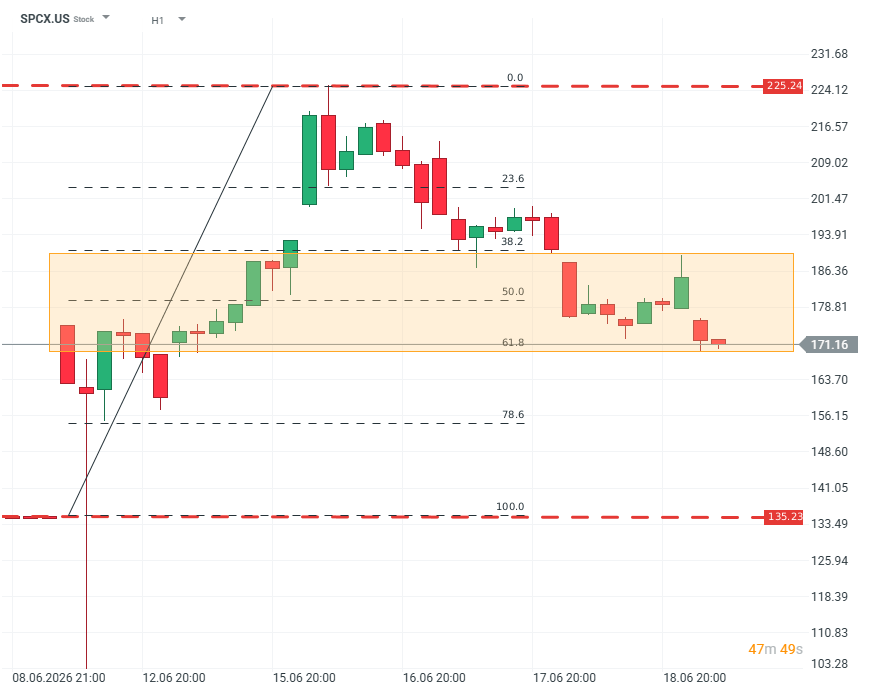
Despite the company’s short trading history, the chart currently shows a consolidation channel between $225 and $135. Based on Fibonacci retracements, the current price is also located in the middle part of this channel. Given the sellers’ momentum and profit-taking by speculators, the base-case scenario can be considered a move toward the area between the 78.6% and 100% Fibonacci retracement levels as correction targets, from which an attempt to break higher could be made. Source: xStation5



Daily Summary- Wall Street Holds Firm While Commodities Plunge on Hawkish Fed


US OPEN: Indices rebound in anticipation of Micron's results


Will Palantir keep declining? Michael Burry weighs in.
Is the market turning away from technology?
